

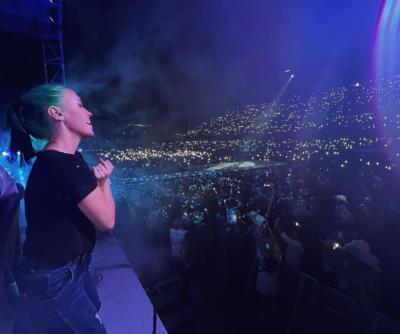
For most people at Cheyenne Frontier Days, the spotlight shines on the stage. Fans pack the stands for Frontier Nights concerts, waiting for their favorite artists to perform beneath the Wyoming sky. But on the side of the stage, another performer is working just as hard to bring the music to life.
For sign language interpreter Camille Gabriele, Cheyenne Frontier Days is more than a summer event.
"No part of it feels like work," she said. "It's my happy place and my happy time."
Camille has become a familiar face at Frontier Nights, interpreting concerts for Deaf and hard-of-hearing guests and helping make CFD accessibility a priority for everyone attending the Daddy of 'em All. But her journey to the stage started long before she ever stepped into the spotlight.
From Hands in Harmony to the Frontier Nights Stage
Camille's introduction to sign language began in fourth grade when the Olympic torch passed through Cheyenne. A local performance group called Hands in Harmony took the stage in sparkling costumes, performing synchronized sign language routines.
The costumes caught her attention first. The performance kept it.
"The way they moved together completely hooked me," she said.
She joined almost immediately and stayed involved for the next 10 years. Later, while attending Laramie County Community College, Camille enrolled in an ASL class to fulfill a language credit. After one of her performances, her instructor, who is now her professional performance partner, told her something that changed everything.
"She told me I could actually make a living doing this," Camille said. "I changed my major the next day."
She eventually attended Idaho State University's sign language interpreting program before landing an internship in Las Vegas, where she spent eight years building her career. In 2022, she returned home to Wyoming and quickly found herself connected to Cheyenne Frontier Days.
Becoming Part of the Show
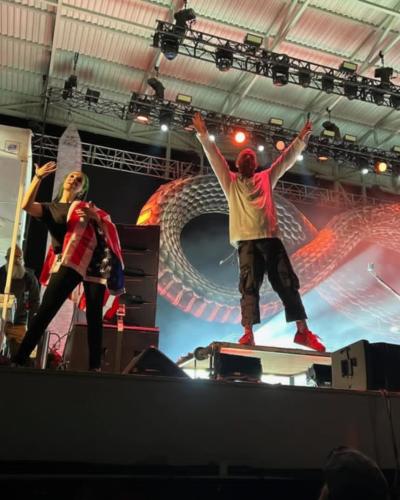
Camille works through Branch Interpreting Alliance, the agency that coordinates her Frontier Nights performances. As their only interpreter based in Cheyenne, she was offered the CFD concerts when she moved back, and she's been part of Frontier Nights every year since.
The combination of live music and sign language felt natural from the start. Her background with Hands in Harmony prepared her for the stage, but she also just genuinely loves performing.
"Without sounding big-headed," she laughed, "I just love being on stage."
Unlike traditional interpreting, live music interpretation is part language and part performance art. Camille studies an artist's style, movement and energy to make sure the experience feels authentic for Deaf and hard-of-hearing fans.
"If George Strait is sitting calmly on a stool, I match that energy," she explained. "If it's Garth Brooks running around the stage, I have to match that too. If I don't, I'm doing a disservice to the fans."
Preparing for the Unexpected
Despite the scale of Frontier Nights, interpreters rarely receive official setlists ahead of time.
"The agency always asks," Camille said, "but usually we don't get them until we arrive, if we get them at all."
So preparation becomes detective work. She researches previous tour stops, studies likely songs and spends hours listening in advance.
"My Spotify top songs are always from concert prep," she joked.
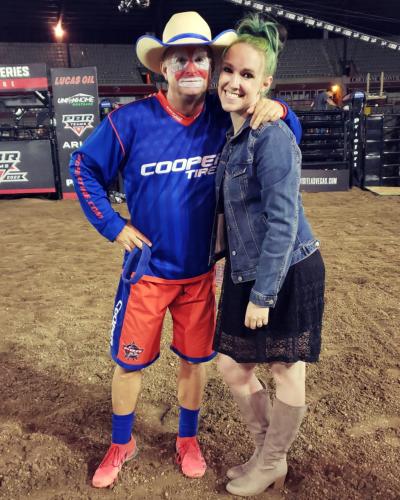
Still, live performance always brings surprises. One of her favorite CFD memories came during a Five Finger Death Punch set, a band she already loved. Then frontman Ivan Moody made it unforgettable.
"Ivan Moody kissing me on the cheek," she said with a smile. "That was definitely memorable."
CFD Accessibility Behind the Scenes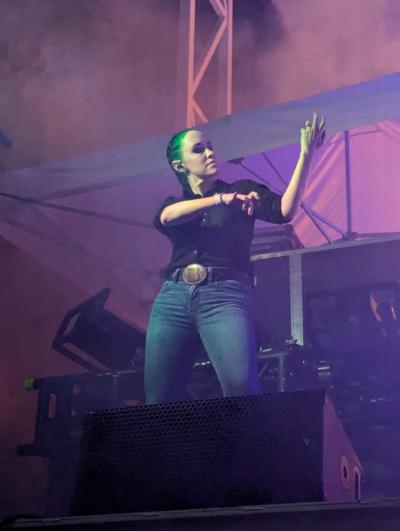
While fans may only notice the interpreters during the show itself, Camille says CFD has made major efforts behind the scenes. The event provides interpreters regardless of whether accommodations are specifically requested, something she says is deeply meaningful for the Deaf and hard-of-hearing community.
"Sometimes people don't want to disclose that they need accommodations," she said. "CFD providing interpreters automatically makes people feel included without having to ask."
Frontier Nights has also added dedicated stage lighting to keep interpreters visible and sound feeds so they can clearly hear the music over crowd noise. Most importantly, Camille says CFD actively advocates for interpreters to stay on stage throughout performances.
"The fact that they fight for interpreters to be on stage for safety and accessibility is huge," she said.
To Camille, that effort is about more than compliance, it's about shared experiences.
"The feeling live music gives me makes me happy. Being able to give that feeling to someone else is everything."
More Than an Accommodation
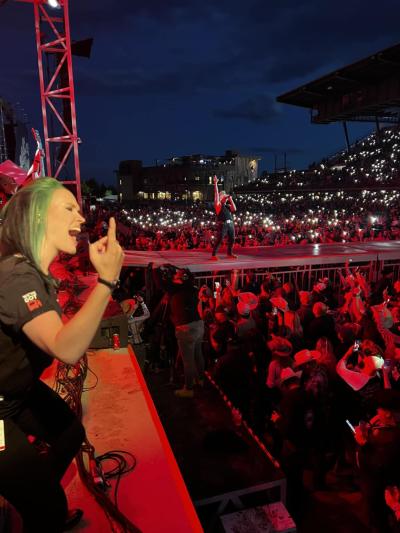
Camille hopes audiences will eventually see interpreters as a natural part of live entertainment rather than a distraction.
"You don't get distracted by the drummer or the guitar player being on stage. I hope interpreters can become just another part of the show."
She believes CFD is helping lead that change by normalizing accessibility at one of the West's biggest events. And every summer, the stage feels like coming home.
"It's my Christmas in July," she said. "I count down from the day it ends to the day it starts again."
Night after night, while thousands of fans sing along beneath the arena lights, Camille stands at the edge of the stage making sure the music reaches everyone in the crowd. Most people may never know her name — but for many fans, her performance is just as meaningful as the one happening center stage.
All photos provided by Camille Gabriele